How to Choose the Best Ant Miner in 2026?
Choosing an Ant Miner in 2026 means comparing more than headline hashrate. Efficiency, measured in joules per terahash (J/TH), shows how much electricity each unit of computing power requires. Bitmain’s published specifications provide a useful starting point, but check the exact model, operating mode, and power consumption before buying. Numbers matter.
Real costs depend on more than the machine. A miner drawing 3.5 kilowatts uses about 84 kilowatt-hours daily. At $0.08 per kilowatt-hour, that is roughly $6.72 per day for electricity alone. Your tariff, cooling needs, and uptime can change the calculation. Small details add up.
Industry data offers context, not a guarantee of profit. The Cambridge Centre for Alternative Finance’s 2022 Bitcoin Mining Network report estimated that 37.6% of mining energy came from sustainable sources. That is a historical estimate, not a forecast for 2026 or a measure of any individual miner’s footprint. The report also illustrates why power sourcing and operating conditions deserve attention. Compare current manufacturer datasheets, warranty terms, noise levels, and service access alongside efficiency. Then estimate daily revenue using current network difficulty and Bitcoin prices, and test less favorable scenarios. Mining economics move quickly; a spreadsheet can look convincing and still miss a weak assumption. The best Ant Miner is the one that fits your electrical setup and budget, not simply the model with the largest advertised hashrate.
Understanding Antminer Models and Their Core Specifications
Choosing a mining unit means comparing more than its advertised hash rate. Check the algorithm, hash rate, power draw, and efficiency, usually listed as joules per terahash (J/TH). Lower J/TH generally means less electricity for the same computing output, but real results depend on temperature and operating settings. Noise and cooling matter too. A compact unit can still push hot air into a small room.
Efficiency deserves close attention. The Cambridge Centre for Alternative Finance’s 2023 Digital Mining Industry Report estimated Bitcoin mining used about 95.5 TWh of electricity in 2021, roughly 0.4% of global consumption. That estimate is not a rating for any individual machine; it shows why power use belongs beside hash rate in a comparison. Check the input voltage and measured wall draw, not just a product sheet. A neat spreadsheet can still miss electrical limits or cooling costs. I would leave room for uncertainty.
Tips:
Compare J/TH at similar operating conditions. Measure outlet temperature and noise in the intended space. Then estimate daily energy cost using your local rate. A test run may disappoint, but it can reveal airflow problems before they become expensive.
Defining Your Mining Goals, Budget, and Operating Conditions
Choosing an ASIC miner starts with a clear goal: steady learning, a small home setup, or commercial-scale operation. Your target determines how much hashrate you need and how much electricity you can afford. The U.S. Energy Information Administration’s February 2024 assessment estimated that U.S. cryptocurrency mining used 0.6% to 2.3% of national electricity in 2023. That wide range reflects changing activity and makes local power costs essential to your calculation. Check your utility rate, circuit capacity, and any time-of-use charges before comparing machines.
Then build a realistic budget around more than the purchase price. Include shipping, ventilation, pool fees, repairs, and possible downtime. The Cambridge Centre for Alternative Finance’s 2023 Digital Mining Industry Report estimated global Bitcoin mining electricity use at about 121 terawatt-hours annually. A single miner is smaller, of course, but its heat and noise can still dominate a room. Measure the available space, check airflow, and consider whether the unit can run without disturbing others. Heat matters. Compare efficiency in joules per terahash, but test your assumptions against actual electricity rates and expected uptime. Profit estimates are not promises; network difficulty and coin prices change. I would leave a cash buffer, even if the spreadsheet says otherwise.
How to Choose the Best Ant Miner in 2026: Daily Electricity Cost by Power Draw
Compare estimated electricity costs for continuous 24-hour operation at a sample electricity rate of $0.10 per kWh. These are planning scenarios, not specifications for particular miners.
How to use this: Multiply a miner’s power draw in kilowatts by 24 hours and your electricity rate to estimate daily energy cost. Actual costs may also include cooling, fees, and downtime.
Comparing Hash Rate, Energy Efficiency, and Total Ownership Costs
How to Choose the Best Ant Miner in 2026?
Hash rate is easy to compare, but it does not tell the whole story. A higher number can mean more potential revenue, yet only when the machine runs reliably and suits your electricity price. Check the stated hash rate alongside its power draw, measured in watts. Small differences matter.
Energy efficiency, usually expressed in joules per terahash, helps show how much electricity each unit of computing power requires. Compare figures from the same testing conditions when possible; manufacturer estimates may not match your room, ventilation, or workload.
Check the wall. A plug-in meter can reveal actual consumption after startup, including cooling equipment. Even a small fan can add to the monthly bill.
Total ownership cost includes more than the purchase price. Estimate electricity over your expected operating period, then account for shipping, setup, maintenance, downtime, and any pool fees. Compare that total with realistic revenue estimates, not a best-case forecast.
No spreadsheet captures every outage. That is an awkward limitation worth admitting.
Leave room for changing network conditions and fluctuating coin prices, and avoid assuming the machine will run at full capacity every day. A practical choice balances hash rate, efficiency, noise, cooling needs, and costs you can verify.
Checking Power, Cooling, Noise, and Facility Requirements
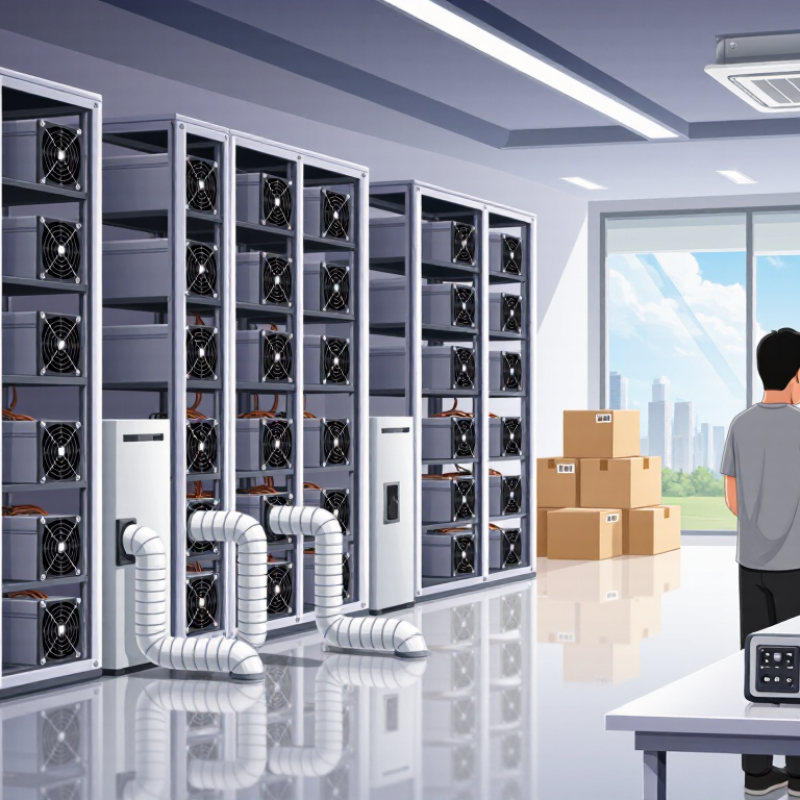
Choosing an Ant miner in 2026 starts with the electrical panel, not the advertised hash rate. Check its continuous power draw, then compare that load with the circuit’s safe capacity and your site’s available power. A 3.5-kilowatt unit releases roughly 11,900 BTU of heat each hour. Heat accumulates fast. ASHRAE’s thermal guidelines recommend inlet temperatures of 18–27°C for typical air-cooled data-center equipment, but each miner’s own operating limits matter more. Measure temperatures at the air intake, not just across the room.
Cooling also adds to the electricity bill. Uptime Institute’s 2024 Global Data Center Survey reported an average power usage effectiveness (PUE) of 1.56. As a rough illustration, a 3.5-kilowatt IT load at that PUE would require about 5.5 kilowatts overall. That figure is a benchmark, not a prediction for your facility. Noise deserves a real test, too: record sound levels where people will work, with the miner running and doors in their normal positions. Check exhaust paths, filter access, and whether hot air can recirculate. Small details matter. I would still leave more cooling headroom than a spreadsheet suggests; airflow changes, and my first estimate may be too neat.
Evaluating Seller Reliability, Warranty, and Model Availability in 2026
Choosing an Ant miner in 2026 is not just a matter of comparing hash rates. The seller matters just as much. Check how long the seller has operated, whether contact details are verifiable, and whether questions receive specific answers. Ask for a dated photo of the exact unit, including its serial label and accessories. A polished product page is not proof of stock. That distinction can be costly.
Read the warranty before paying. Confirm its length, what failures it covers, who pays shipping, and where repairs happen. Get those terms in writing; vague promises are hard to use later. Model availability can shift quickly, so confirm the unit is ready to ship rather than merely listed. Request a realistic dispatch date and tracking details. Also compare the power supply, noise level, and electrical requirements with your setup. A machine that cannot run safely in its intended space is a poor purchase, whatever its headline performance. I would still leave room for doubt: listings and delivery estimates can change. Keep records of messages, invoices, and payment terms.